Bedivere Crosses The Pools
A Poem
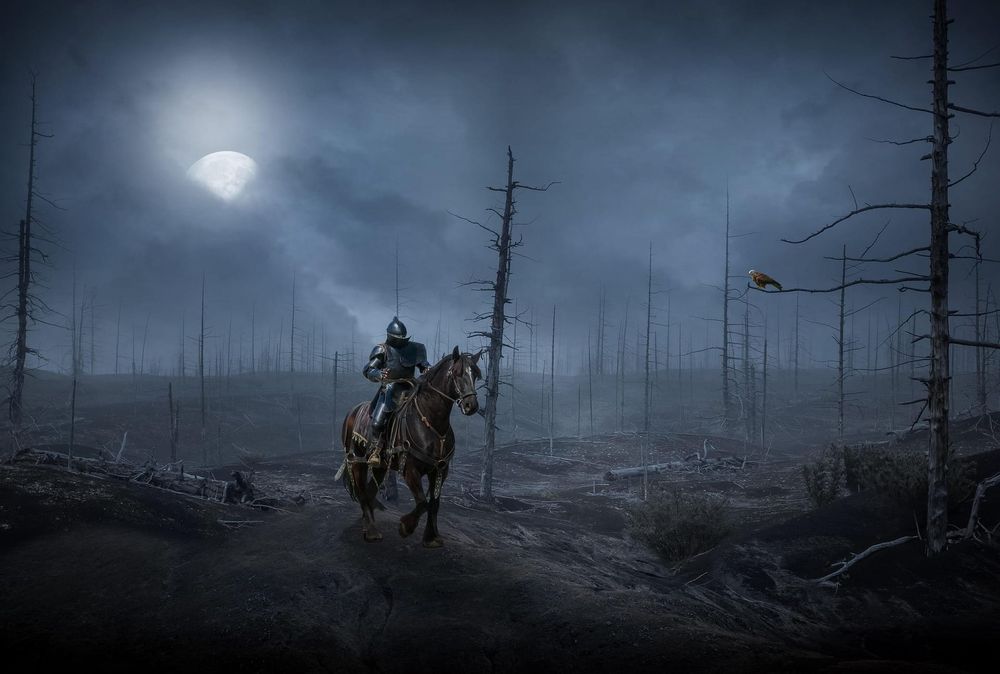
Text within this block will maintain its original spacing when publishedMoonlight mirrored back from marshland peat-pools
Finds me daring to defy the good-night;
For as I gaze the ground, there goes a knight
In tarnished armour, hardly still a ghoul.
Look long upon his silvered locks of hair
That bind him like the binding on his bone,
Gauntlets growing into gilded death-stone
That's carved its casques, their carrion left bare.
When was it that my armour became me?
Have sips of soul been slurped from its chalice?
A corpse is worn under chains of malice -
Should I ride on, will their reign cease to be?
Moonlight mirrors back from blooded eyeballs
That (for a dream) dare to defy good-nights.
For as I gaze the ground, there goes us knights
In tarnished armour, for verity calls.
Bedivere Crosses The Pools - By Tom Shaw
If you visit the suburb of Crosspool in Sheffield, England, you would be hard-pressed to find any ponds or large bodies of water left there, save for one-or-two now enclosed within private property. Almost all of them were drained throughout the 1900s to make way for new housing developments, creating the modern-day suburb that exists there today - the place I grew up in, and the place that birthed the poem you read above during my brief return there in March.
And yet, the pools that use to be here - some natural, some from past quarrying that occurred in the area - is exactly where this area gets its name from. Travellers taking the road from Sheffield into the Peak District would “cross the pools” and follow a route used since Roman times known as the Long Causeway. It’s believed the Romans built this route to connect their forts at Templeborough (now part of Rotherham) and Buxton. The area around the route would later be designated as deer-hunting territory following the Norman Conquest of England. Unlike other suburbs of the city, there was never a traditional village here, but as it was the place where two major routes through the Peak District into Sheffield merged, it was a natural location for a toll gate - and later blacksmiths, inns, and lodges for Lords looking to deer-hunt - to be built. Now, it is like any other suburb, with a set of shops, a few churches, schools, and houses around it. The odd park, too.
But no “pools” to cross.
I find it curious how we are willing to desecrate natural features in the name of “progress” - indeed, the lakes were never drained for many years because house-builders thought it would be undesirable for people to live there. And yet, with the rapid growth of cities in postwar periods, there was no hesitation to disregard the natural features and fill in the landscape with (predominately) housing. It is a symptom of the push towards industrialisation, which I increasingly find myself thinking had more to do with driving people out of independent, self-sufficient, organically-developing villages (and into highly-controllable, artificial environments) than it does meaningful technological advancement.
 Tom Shaw
What have we witnessed in England in recent times? We’ve seen swathes of farmland bought up for solar- and wind farms and data-centers. We’ve seen truly “local” shops giving way to chain stores, tourism-oriented uses or those that live more in the online space than they do in-person. We’ve seen beautiful buildings using local materials swept away in favour of high-rise concrete and glass - with the ones remaining being retrofitted in “eco-friendly” ways that hollow out the soul. We’ve seen the proliferation of antennas and wireless communication infrastructure take over the skylines and the streets, with little regard to what a plethora of artificial EMFs do to the health of the people or the planet.
I’m not advocating for some return to “beans-in-the-woods” primitive lifestyle (although I do feel that option should be available for those who genuinely want to live that way). We have so many ways to generate clean electricity, communicate long-distance, build enough places to live, be healthy and provide enough food and resources for everyone on the planet - all of which don’t require us desecrating ourselves and our surroundings in its pursuit. Being involved with initiatives like Anarchapulco and Solari’s Young Builders has given me optimism that it is indeed possible to get there, even with the individual circumstances of different geographies and cultures.
The pursuits of King Arthur - before “his-(s)tory” was modified with the search for the Grail - still capture that ideal. The earliest records tell of an Arthur who fearlessly defends the Britons from re-capture by external forces who do not appreciate the value of Britain’s independence. It tells of an Arthur who only resorted to forceful self-defence when all other avenues were exhausted. It tells of an Arthur whose fierce generosity and benevolence towards the Britons allows the proliferation of art, culture and beautiful creation across the realm. I can only imagine Arthur’s knights (and perhaps Arthur himself!) constantly have to question themselves and their deeds to ensure they are still aligned with their moral compass.
That’s where this poem comes from, and what I hope inspires you in times of your own self-doubt and self-judgement.
Your Turn
It is this practise of writing poetry that acts as my own method of finding what I know to be true, and to remind me of my own place and purpose in the world. Perhaps it can be yours too.
I’d love to see your own attempts at poetry based on something I’ve shared here today. Perhaps this piece alone has already sparked some ideas - if so, great! If you need some additional prompts, here are some you can find in my Poetic Realignment Bundle:
- What is the armour you put on to feel safe?
- What was the last question you asked yourself?
- Who do you see in the mirror?
Leave me your responses using the button below:
Finally, for those of you who caught my Anarchapulco talk this year, you may remember that I did not have my slides available to me due to a technical issue. I was still very happy with the improvised version of the talk I ultimately delivered… and, I would still like the opportunity to share with you all the intended version of my talk.
To this effect, I will be doing a free presentation next Wednesday (8th April) at 7pm UK Time / 2pm Eastern Time to deliver You Are Permission - or, what should have been the talk I gave at Anarchapulco, featuring insights on how words can affect physical matter, the use of language to change our life story, and - of course - plenty of poetry from myself and other poets throughout history. This session will not be recorded!
Sign up in advance through my website using the button below, and you’ll get an email just before it begins with the details on how to join:
Thank you for making time to read this piece. I look forward to bringing you more soon.
With gratitude,
Tom