Will ChatGPT Turn Us Into Poets?
The unintentional consequence of AI language models, and how we might get a new wave of excellent poets that will prove why human creativity cannot be matched.
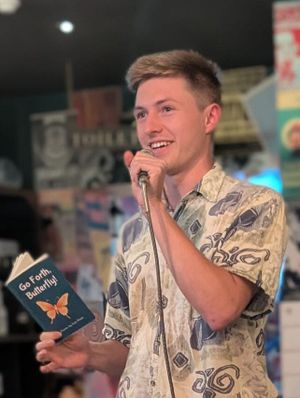
I’ve experimented a couple of times with seeing whether AI can generate poetry, purely out of curiosity for what it can come up with. The results were generally so appalling that I didn’t even save them anywhere for sharing at a future date, as nobody should be subject to them.
There is maybe one exception to this - a poem called Travelled, included in my latest book, Go Forth, Butterfly. Here, I used AI to put Robert Louis Stevenson’s poem, Travel, through one neighbouring language after another, as if it were “travelling” around the world, before being put back into English. As you might expect, the final result was a bit garbage, but it did produce one or two phrases that, with some tweaking, could be interesting. However, the overall narrative had very much been lost. As such, the final step involved me re-interpreting the AI output as a meaningful poem, resulting in something that AI could never have produced.
You can see the final result below:
Text within this block will maintain its original spacing when publishedI felt the calling to be free,
To go beyond my apple tree,
To be a witness to a star,
That graces island shores afar.
Where parrots put their moorings down:
No goat- nor otter-shipping town.
Dotted along sunlit roadways,
Countless mosque and minaret lays,
Sprawling east, adorned with their runes
Nestled within their sandy dunes.
From where do all their riches stem?
From bazaars trading rock for gem?
Along the Great Wall of China,
Carrying a desert miner?
To walk amongst those songs of flutes
And holy bells lining the routes
That weave the forests where they burn
Their losses with the twigs and fern.
Monkey caves, a coconut king,
Only when dark, their hunters spring—
Do they move like the crocodile
That lies in wait within the Nile?
Or red flamingos who try flee
With fish-in-beak towards the sea?
Savannahs rear hold distant roars
Of lions eating men and boars.
The animals are hesitant
To try approach this resident;
Their destination is unclear
So in the bush they hide with fear.
Driven to their abandonment,
Towns deserted of government,
Once a place where children grew up
To sip wine from a golden cup—
Now between each street and dwelling,
Even mice will do no selling.
Absent even of candlelight,
The future here must have lost sight.
Were I a man, then I would go
By camel-cart to find some glow
Still alive within some kitchen
Where they ask the dust to pitch-in.
Portraits sitting around tables,
Heroes of some long-lost fables,
The corner where they’re always found
Playing a never-ending round...
Poetry is, by its very nature, a generative art form rather than an imitative art form. Poetry relies on novel descriptions, metaphors, and more abstract observations and connections between different things, to help us see something from our past experiences in a new light. It then uses poetic techniques like repetition, syllable structures, rhyme and so forth to help engrain this new way of seeing into us, and to expand on the initial ideas in a controlled yet impactful way.
So-called “generative” AI does not get this, because it works purely through imitating the data and information that it has been fed with. It can often pick up on rhyming structures and metrical feet; the patterned part of poetry. But the metaphorical contents - the spiritual and emotional core - is lost on AI, precisely because it requires a human being to interpret it.
Neither can AI read a poem live and in-person (no, those AI voice interpretations don’t count). Hearing poetry read aloud by someone in their natural cadence, pitch and rhythm - even when not the original person who wrote the poem - can be a moving and cathartic experience. I’ve seen this much in the countless poetry nights, open mics, and performances I’ve been honoured to visit as both a performer and an audience member, as well as creative writing workshops that I continue to run.
All this goes to illuminate how great poetry will be the downfall of AI “taking over” creative spaces: AI does not have a soul to speak from or to. That soul-speaking is something we always need, and that we are arguably in more need of now than ever before.
I am not totally against the use of AI in some use-cases. AI is, put simply, a specific programming technique for being able to repeat and relay data that it already has access to. Its use as a tool to search through vast databases and pull out information that may be useful to a human being, in lightning speed, is really useful. Here, AI is not being used to generate the end-product, but is simply speeding up a process that is a uniquely human product. The intention is not to replace human creativity. It is the difference between using hand tools to dig out a building’s foundations over a digger. I’d much rather use the latter.
But there is something else that AI is doing that might actually help human creativity in the long run - something that seems to be a completely unintended consequence of the rise of LLMs like ChatGPT, Grok and Claude.
Becoming Conscious of our Words
The rise of publicly-accessible LLMs has generated an entire sub-industry around prompts. Prompts are the inputs that we type into AI: questions, queries and demands. The way we phrase our questions, and the level of detail we include, can massively affect the way that AI models siphon through data and prioritise what to show us as the result of our queries. This has given rise to a growing industry of “prompt engineering” - companies, organisations and individuals that specialise in how to tell AI exactly the right words to get the most desirable result possible.
Suddenly, the tech bros and 21st-century entrepreneurs of the world are:
- Being as precise as possible with the individual words they are using
- Being cognisant of the overall structure and format of the written passages they are creating
- Using voices, personas and contexts to shape the trajectory of their work
And what are poets known for doing?
- Being as precise as possible with the individual words they are using
- Being cognisant of the overall structure and format of the written passages they are creating
- Using voices, personas and contexts to shape the trajectory of their work
In a very strange turn of events, people using AI are now engaging in many of the acts and hallmarks of traditional, formal poetry.
The fact that people are becoming more conscious of the words they are using is exciting to me - even if it is within a highly specialised context. I do think this hyper-vigilance towards finding the best words to use in any given situation will extend out into all areas of life. When we combine this with the right intention and “heart” to our words, a world where the pen is mightier than the sword is not only possible, but already real.
 Tom Shaw
The Missing Piece
There’s just one thing missing in all this: AI prompting is devoid of the emotional, spiritual contents that characterises poetry and that speaks to the human experience. What’s more, I believe that it never will, because the audience of these “prompts” is not human, but AI.
But what will happen when the AI bubble bursts, and the tech entrepreneurs of the current times take their skills in linguistics with them into other, more human areas of life? Given the growing (and long-overdue) backlash to the technological, anti-human “enshittification” of modern life, I don’t think it’s unreasonable that we can expect a future where there is far less digital technology impacting how we live our daily lives. To me, it already shows in the desire to move to in-person working environments, and in the growing number of people quitting social media and seeking in-person experiences. I think it shows, too, in how in-person poetry experiences are gaining in popularity, too. Here are spaces where people connect in a soulful, face-to-face experience, without the interference of artificial blue light and digitised voices.
Poetry has outlived entire civilisations, with all their conflicts, destructions, and technological leaps and bounds. It will surely outlive AI at the very least - and if not, may also be the very thing that destroys it.