Death Shall Have No Dominion
An exploration of the poems of Dylan Thomas - and his showcase of using poetry to move through grief.
Text within this block will maintain its original spacing when publishedDo not go gentle into that good night,
Old age should burn and rave at close of day;
Rage, rage against the dying of the light.
Though wise men at their end know dark is right,
Because their words had forked no lightning they
Do not go gentle into that good night.
Good men, the last wave by, crying how bright
Their frail deeds might have danced in a green bay,
Rage, rage against the dying of the light.
Wild men who caught and sang the sun in flight,
And learn, too late, they grieved it on its way,
Do not go gentle into that good night.
Grave men, near death, who see with blinding sight
Blind eyes could blaze like meteors and be gay,
Rage, rage against the dying of the light.
And you, my father, there on the sad height,
Curse, bless, me now with your fierce tears, I pray.
Do not go gentle into that good night.
Rage, rage against the dying of the light.
Do Not Go Gentle Into That Goodnight ~ By Dylan Thomas
Do Not Go Gentle Into That Goodnight is perhaps Dylan Thomas’ most famous poem, written in response to the increasing frailty and likely imminent death of his father. Death became a defining theme of Thomas’ poetry, right up to his own passing. Only two years after publishing the poem, Thomas himself would pass away. The precise cause remains debated, with illness, heavy drinking and complications from prescription drugs all suggested as contributing factors.
Dylan Thomas’ life was troubled. He struggled with bronchitis and severe asthma from childhood. Progressing into adulthood, drinking, seeking loans, and his tensions around the state of the world all increasingly characterised his life. Though he married, he had numerous affairs, and would regularly be taken on holiday from his friends in the hopes he would turn to writing more poetry. In many respects, he is not necessarily a great role-model for what “survival” looks like.
Yet, his passion for poetry never waned - in fact, he considered it his most important work, even above the newspaper reporting, documentary writing, and various tours he would do in order to keep money coming in when his poetry wasn’t bringing any in. Poetry was where he was most disciplined, spending much of his time re-drafting and reworking poems to a point he was satisfied with them; a space where he could create something out of personal insecurities, rather than be overtaken by them. This reflects in the content of Thomas’ poems: he was highly reluctant to ever record his personal experiences directly as poetry, but was far more interested in drawing out the emotions and themes from the experiences he did have, and turning them into something new where he - and other readers - could find sense and respite from the world around them.
And he became a master of his craft, with Do Not Go Gentle being a prime example of his mastery. By turning to the traditional villanelle form (characterised by the repeated refrains “Do not go gentle..." and "Rage, rage against the dying of the light"), Thomas mirrors how he finds his private grief relative to some cosmic, universal pattern that is beyond his immediate control. Each stanza presents a different kind of personality (wise, good, wild and grave), showing that every life, however different, can find reasons to resist death. Thomas' refrain insists that there is never a place to meet your end passively - and to instead live to our fullest capacity before we pass.
Poems like this have made Dylan Thomas into perhaps one of the most well-known English language poets of the 1900s, with his poems on death being held in particularly high regard. Perhaps his second best-know poem - And Death Shall Have No Dominion - challenges the idea that we should be restricted and fearful of the prospect of death, in a way that Thomas doesn’t fully align with at the time of Do Not Go Gentle’s writing:
Text within this block will maintain its original spacing when publishedAnd death shall have no dominion.
Dead man naked they shall be one
With the man in the wind and the west moon;
When their bones are picked clean and the clean bones gone,
They shall have stars at elbow and foot;
Though they go mad they shall be sane,
Though they sink through the sea they shall rise again;
Though lovers be lost love shall not;
And death shall have no dominion.
And death shall have no dominion.
Under the windings of the sea
They lying long shall not die windily;
Twisting on racks when sinews give way,
Strapped to a wheel, yet they shall not break;
Faith in their hands shall snap in two,
And the unicorn evils run them through;
Split all ends up they shan’t crack;
And death shall have no dominion.
And death shall have no dominion.
No more may gulls cry at their ears
Or waves break loud on the seashores;
Where blew a flower may a flower no more
Lift its head to the blows of the rain;
Though they be mad and dead as nails,
Heads of the characters hammer through daisies;
Break in the sun till the sun breaks down,
And death shall have no dominion.
And Death Shall Have No Dominion ~ By Dylan Thomas
Rather than replacing his view on death, Thomas seems to enlarge it. While death should not be feared, it doesn’t mean we should just “give up” on life when the going gets tough. He sees and values the emotional and personal consequences of facing death in a way that seems absent in his recent work - something that requires the mastery found through his poetic experience to bridge this otherwise contradictory outlook into something coherent and powerful. And Death Shall Have No Dominion insists that death cannot conquer the human spirit; Do Not Go Gentle insists that this is no reason to surrender life before its time.
Dylan Thomas’ later life seems to give this poem additional poignancy. Thomas was still persisting on tours and show appearances right up to the end of his life, sometimes even collapsing on-stage from fever and illness. He seems to have moved from death being some far-off inevitability - perhaps because he didn’t feel anywhere close to death himself - to a pressing and immediate reality that forces us to make the most of the hours we have left. In Thomas’ case, this was for the pursuit of his poetry and writing. It was not from a place of desperation and guilt of a life “not lived well enough”, but a recognition of the value of life and the magic we can create for ourselves and others in our time here.
There is one final project on death that Dylan Thomas began that, ironically, he never finished before his own passing. Elegy was intended as a full tribute to his then-deceased father, and the final version that was released was a combination of finished verse, and drafts he was working on, by his friend Vernon Watkins. Some of the themes of Do Not Go Gentle are certainly here, along with And Death Shall Have No Dominion, and ironically gives us his most complete view on his approach to death, despite being unfinished.
Text within this block will maintain its original spacing when publishedToo proud to die; broken and blind he died
The darkest way, and did not turn away,
A cold kind man brave in his narrow pride
On that darkest day, Oh, forever may
He lie lightly, at last, on the last, crossed
Hill, under the grass, in love, and there grow
Young among the long flocks, and never lie lost
Or still all the numberless days of his death, though
Above all he longed for his mother's breast
Which was rest and dust, and in the kind ground
The darkest justice of death, blind and unblessed.
Let him find no rest but be fathered and found,
I prayed in the crouching room, by his blind bed,
In the muted house, one minute before
Noon, and night, and light. the rivers of the dead
Veined his poor hand I held, and I saw
Through his unseeing eyes to the roots of the sea.
(An old tormented man three-quarters blind,
I am not too proud to cry that He and he
Will never never go out of my mind.
All his bones crying, and poor in all but pain,
Being innocent, he dreaded that he died
Hating his God, but what he was was plain:
An old kind man brave in his burning pride.
The sticks of the house were his; his books he owned.
Even as a baby he had never cried;
Nor did he now, save to his secret wound.
Out of his eyes I saw the last light glide.
Here among the light of the lording sky
An old man is with me where I go
Walking in the meadows of his son's eye
On whom a world of ills came down like snow.
He cried as he died, fearing at last the spheres'
Last sound, the world going out without a breath:
Too proud to cry, too frail to check the tears,
And caught between two nights, blindness and death.
O deepest wound of all that he should die
On that darkest day. oh, he could hide
The tears out of his eyes, too proud to cry.
Until I die he will not leave my side.)
Elegy ~ By Dylan Thomas
It’s here that we find acceptance and forgiveness; forgiveness of those unable to let go of their life when their time has come - almost as if it were a synthesis on all Thomas’ previous thoughts and experiences with death. Reading it now, it’s tempting to feel that Thomas himself had begun moving towards a quieter acceptance of mortality - perhaps not just his father’s, but also his own.
What I take from Thomas’ work and life is this: It is not our role to define how we pass, or how we will be remembered by others. When we are not afraid of having to go through the checklist of a “successful life” before we die, and instead work on making the quality of our character the best it can be at any given moment, that is what created the conditions for death to “have no dominion” on our beliefs or actions, allowing us to step away from the fear narratives that come with it. We will be remembered for the “kind” and “brave” within us, if we choose for that to be seen by others - and whatever fears, doubts and self-limiting beliefs we torture ourselves with do not have to define who we are, and the legacy we leave.
Holding on to agony and desperation that we must let go of the little progress we did make: that is not “survival”. And we will go through a life where we witness the passing - sometimes tragic and seemingly unfair passing - of others, or close to our own passing. But all this time, we are in control - even when the circumstances are stacked against us, and our hours are limited. We still get to choose to be the best we can, to live for a principle and purpose that has meaningful consequences beyond ourselves. We may not have always chosen best in the past - but that doesn’t mean we can’t do so now - right now - and move through whatever challenges we face.
Dylan Thomas’ work suggests that we cannot control death itself, only how we meet it. Whether through resistance, acceptance, or generosity that outlives us, the dignity lies in the life we continue to choose while it remains ours. And it is through poetry that he found this, and made the case in support of “surviving” to the very end.
Your Turn
With this in mind, I invite you to do the following:
- Choose one of the poems above that moved you the most, and one line which particularly stood out to you.
- Use this line as the title for your own poem.
- If you need an additional prompt, see if you can use your poem to answer the question: How do I want to be remembered?
Leave your creations as a comment for me - I look forward to reading them 👇
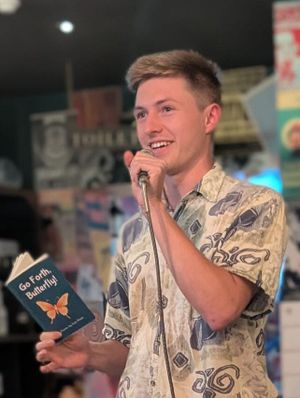
Thank you for making time to read this piece. If you’d like to support me to create more pieces like this, consider purchasing my latest poetry book, Go Forth, Butterfly! direct from my website.
I look forward to bringing you more soon.
With gratitude,
Tom